






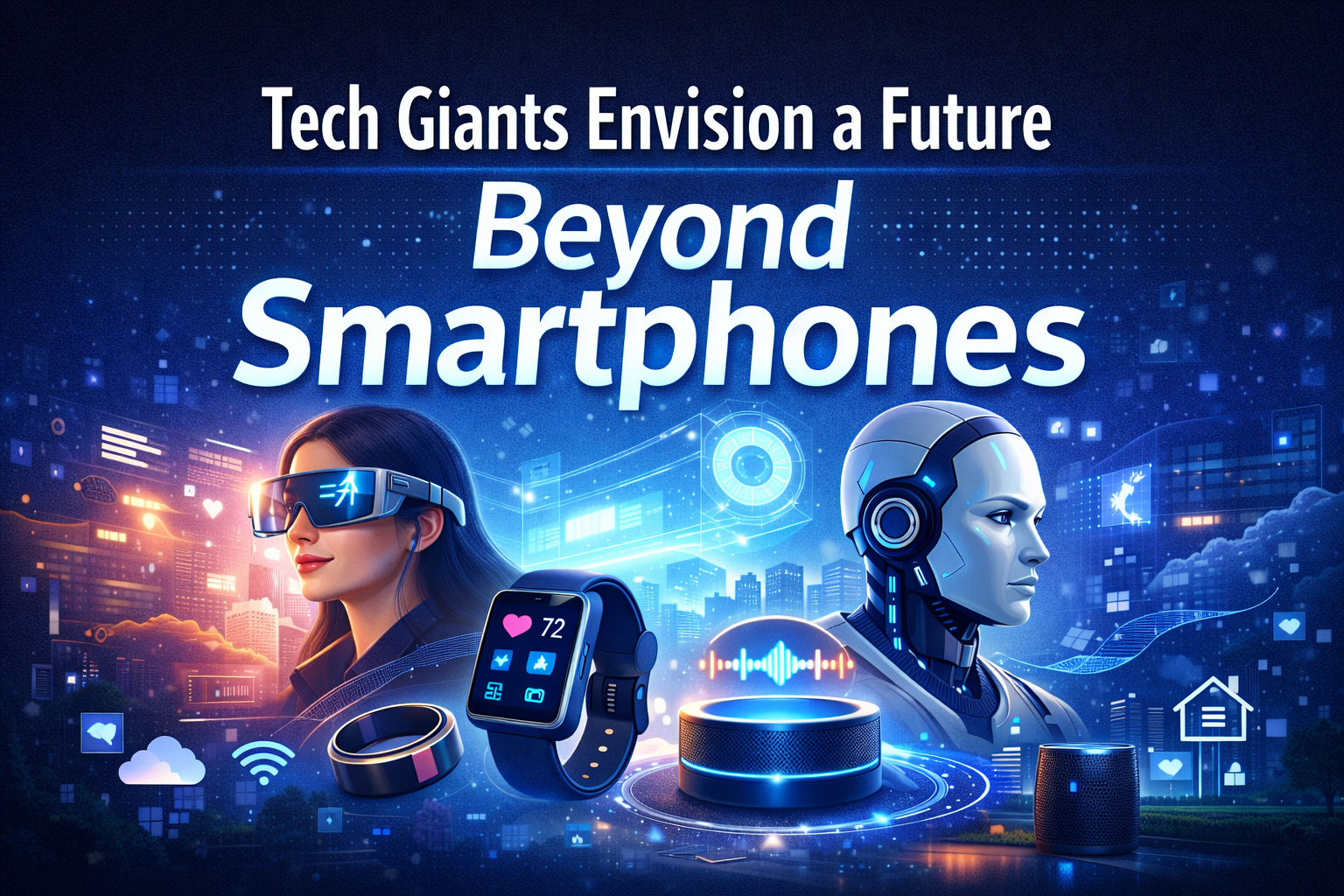
For more than a decade, smartphones have been the centerpiece of the digital world. They reshaped communication, entertainment, commerce, and even how societies function. But today, many tech giants are openly signaling that the smartphone era may be approaching its next evolution. Instead of relying on a single rectangular device, the future appears to be more distributed, immersive, and seamlessly integrated into everyday life.
Why Tech Giants Are Looking Beyond Smartphones
Market saturation is one of the biggest reasons. Most people who want a smartphone already own one, and year-to-year upgrades offer only incremental improvements. At the same time, breakthroughs in artificial intelligence, spatial computing, wearables, and connectivity are opening doors to entirely new ways of interacting with technology.
Companies such as Apple, Google, Meta, Microsoft, and Samsung are investing heavily in platforms that reduce dependence on traditional screens while increasing contextual, hands-free, and immersive experiences.
Emerging Technologies Shaping the Post-Smartphone Era
Wearables and Ambient Computing
Smartwatches, smart rings, and health trackers are becoming more powerful, handling notifications, payments, and health monitoring independently. These devices aim to deliver information exactly when needed, without requiring constant screen time.
Augmented and Mixed Reality
Augmented reality (AR) and mixed reality (MR) headsets are designed to overlay digital information onto the physical world. Instead of pulling out a phone, users could see navigation, messages, or work tools directly in their field of vision.
Artificial Intelligence as an Interface
AI is increasingly becoming the primary interface between humans and machines. Voice assistants, predictive systems, and on-device AI can anticipate needs, summarize information, and perform tasks automatically—reducing the need for manual interaction with apps.
Connected Ecosystems
Rather than one dominant device, tech giants envision ecosystems of interconnected products—home devices, cars, wearables, and cloud services—all working together. The smartphone may remain part of this ecosystem, but no longer as the central hub.
What This Means for Consumers
For users, a future beyond smartphones could mean less screen addiction, more natural interactions, and technology that blends into daily life instead of demanding attention. However, it also raises concerns around privacy, data collection, and dependency on always-on systems.
The transition is expected to be gradual. Smartphones are unlikely to disappear anytime soon, but their role may diminish as new interfaces mature and gain mass adoption.
Frequently Asked Questions (FAQ)
Q1: Will smartphones completely disappear in the future?
No. Smartphones are expected to remain relevant for many years. The shift is more about reducing reliance on them as the primary interface, not eliminating them entirely.
Q2: What devices could replace smartphones?
Likely candidates include AR glasses, advanced wearables, voice-first AI devices, and interconnected smart environments rather than a single replacement device.
Q3: Why are tech companies pushing this change now?
Slower smartphone innovation, market saturation, and rapid advances in AI, sensors, and computing power are driving companies to explore new platforms.
Q4: Is this future affordable for everyday users?
Initially, new technologies tend to be expensive. Over time, as production scales and competition increases, costs are expected to come down.
Q5: What about privacy and security?
Privacy is a major concern. Devices that are always listening or observing require strong regulations, transparent policies, and user control to ensure trust and safety.
Disclaimer
This article is for informational and educational purposes only. It reflects current trends, projections, and strategic directions discussed by major technology companies, which are subject to change. The technologies mentioned may evolve differently than anticipated, and timelines for adoption are speculative. Readers should not interpret this content as investment, legal, or professional advice.